
The Agentic Builder Series · 11 rungs
Becoming an Agentic Builder
If you can think it, you can build it.
tropo
The Agentic Builders · Becoming an Agentic Builder · Overview · · 4 min read
Your guide to going from "I use an agent to answer questions" to "I direct agents to build the software I need" — no code, and you own all of it.
You already know how to do the hard part.
You write briefs. You hand work to people and judge what comes back. You know the difference between a request that gets you what you wanted and one that gets you a shrug. That skill — describing an outcome clearly enough that someone else can hit it — is the whole job of directing an agent to build. You have been practicing it for years on people. What changed is who else you can hand the work to now.
An agent can write software. Real, working software: the tool you keep wishing existed, the tracker you rebuild in a spreadsheet every quarter, the thing you would pay for if only it did exactly what you needed. You do not write the code. You describe what you want, look at what came back, and steer. If you can think it clearly, you can build it.
It is doable. It is not automatic. It asks something of you — a shift in how you work, and a measure of curiosity, creativity, and persistence. This series is how you make the shift.
The one skill, sharpened eleven times
Everything here is one loop: spec → direct → checkpoint → verify. You describe the outcome. You let the agent build. You check in at the points that matter. And you verify that what came back is actually right — not that it looks finished, that it is correct. That last part is half the job, and often the harder half. We call it the Build Loop, and once you see it you will run it on everything.
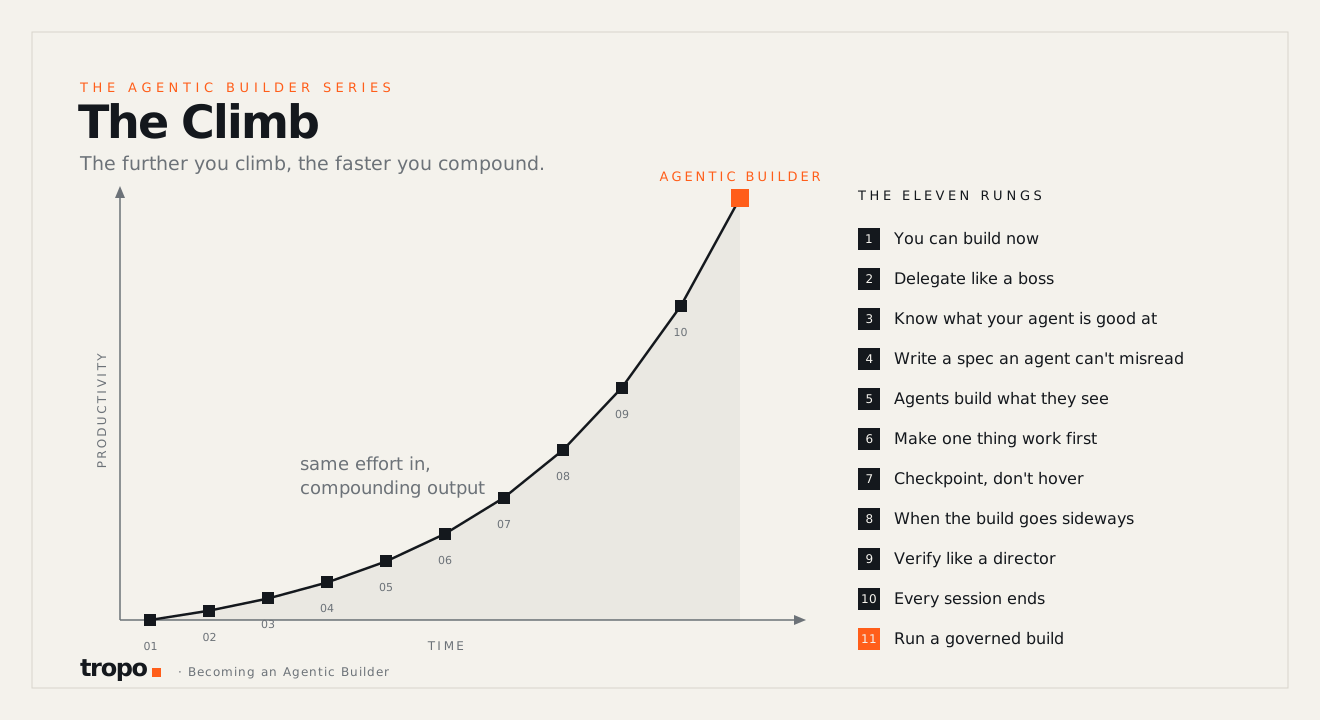
The eleven rungs are that same loop at rising stakes. Rung one gets a working tool into your hands in fifteen minutes. By rung eleven you are running a governed build on real data, and the trail of decisions and checks behind it is your proof the work is sound. The concepts do not multiply as you climb. The stakes do.
Read it, then run it
Each rung comes in two pieces. The essay is the judgment — what the move is, why it matters the moment real work is on the line, and how to think like a director making it. It stands on its own; you get value with nothing installed. The companion — "In Tropo:" — is the doing: a ready-to-use spec you drop into your own studio, a build to run, and a checklist to verify it. You finish each rung having built the thing, not having read about it.
You do not need code, a cloud, or a budget. You need a studio on your own machine and the willingness to direct.
The ladder
Eleven rungs, from "I got a tool working today" to "I run governed builds I trust."
- You can build now. Drop in a spec, get a working tool in fifteen minutes, then change the spec and watch the software change.
- Delegate like a boss. Fix what you are asking for before you fix how it is built — the appetite comes first.
- Know what your agent is good at. Where it is brilliant, where it bluffs, and what to hand it versus hold back.
- Write a spec an agent can't misread. Make the outcome clear enough that the agent restates the plan before it builds.
- Agents build what they see. They follow the patterns in front of them; your leverage is curating what is in view.
- Make one thing work first. One excellent thing end to end beats five half-built ones.
- Checkpoint, don't hover. Decisions at the checkpoints that matter, not approvals at every gate.
- When the build goes sideways. Correct twice, then take it back — the escalation ladder for a build gone wrong.
- Verify like a director. Make "done" mean proven. The receipt is the review.
- Every session ends. The agent forgets tomorrow; what survives is what you wrote down. Hand off so the next session resumes from files alone.
- Run a governed build. The full loop at real stakes — and the trail behind it is the credential.
Start climbing
Tropo is open-source and free. It runs on any Mac, and on any PC with Python.
If you have been through Getting Started with Agents, you already have a studio to build in. If not, that is the fastest place to start. Then begin on rung one and get something working today. Read each essay, then run its companion in your own studio as you go. That is how an agentic builder is actually made.
You do not read your way there. You build your way there.
Let's build.