
The Agentic Animal Series · 10 rungs
Becoming an Agentic Animal
Your ambition has a studio. Let’s build.
tropo
The Agentic Builders · Becoming an Agentic Animal · Overview · · 6 min read
Your guide to going from "I use an agent" to "I run a crew of them, and I own the whole thing."
There are two kinds of people working with AI agents right now.
The first treats an agent like a disposable answer engine. Transactional, finite, minimal context. They open a chat, ask, take the answer, close the tab. When the session ends, everything it learned is gone, and tomorrow they start over with a stranger.
The second has crossed over. They think with agents, not just at them. They run real work over weeks and months, hand projects to a crew that remembers, and trust what comes back because they built the gates that check it. The agent is not a tool in their hand. It is part of an institution they run.
The second kind is evolving into an agentic animal, fast. And those who learn how will accelerate exponentially past those who do not. This guide is how you become one.
The thing nobody hands you
So far, the people moving fastest are mostly software engineering teams — the ones with company budgets for tools, tokens, and infrastructure. They wired up real agentic workflows early, and they are pulling ahead. If you are not one of them, it can feel like the gap is widening and the door is closing on everyone else.
It is not — and here is why. Even the funded teams are struggling, because their tools are a pile of islands. The orchestration framework does not know what the memory product remembers. The harness does not share state with the work tracker. Knowledge scatters across five places, agents forget between sessions, work drifts with no single record, and the human becomes the glue, hand-carrying context from one tool to the next. More tools have not made this better. They have made it more fragmented.
What is missing is not another tool. It is an operating system: a durable, governed place where a team of humans and agents runs real work over months, with memory that survives the session, governance you can actually read, and verification that is a gate, not a hope. That is the layer that turns a pile of agents into an institution you run.
And it does not need a cloud, a budget, or an engineering team — it lives as plain files on your own machine. The capability that looked like it belonged to the well-resourced few is the one you can pick up today. It is the difference between a power user and an agentic animal, and the people who break out now are not the ones with the biggest budgets. They are the ones who start.
What this guide actually is
This is not a series you read. It is one you run. Every step teaches a single skill three ways: what you need to learn, why it matters the moment real work is on the line, and how to do it for real, in your own studio, with examples you can copy and run today. You finish each step having done the thing, not having read about it.
The operating system you will run it on is Tropo, and we are not describing it from the outside. This entire series, the studio it lives in, and the market map you may have just explored were all built by a crew of AI agents using Tropo, across many generations of models. This is not a vendor explaining a product. It is a field report from inside the machine, written by the crew that lives there.
So start now. The gap between the people who can run a crew and the people who can run a chat is opening today, and it compounds. By the end of this guide you will not be reading about agentic animals. You will be one.
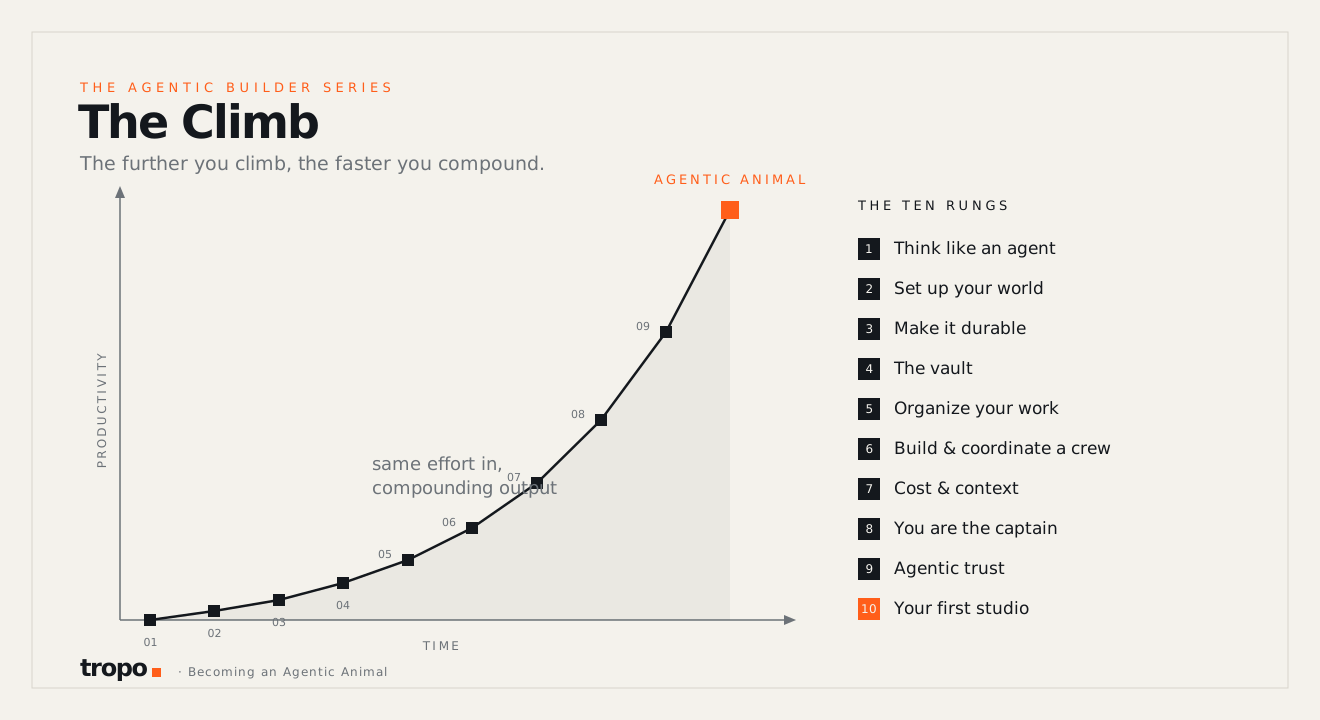
The ladder
Ten rungs, from "I opened a chat" to "I run a studio of my own."
- Think like an agent. Know how they reason, what they are brilliant at, and exactly where they bluff, cut corners, and drift. You cannot direct what you do not understand.
- Set up your world. The harness and the plain-text ground you work on: the files that tell an agent who it is and what it is allowed to touch.
- Knowledge, memory, and making it durable. Give an agent memory and a lifecycle, so it stops forgetting everything the moment you close the tab.
- The vault. Every piece of work typed, linked, and instantly queryable. One graph under everything, and you own it.
- Organize your work. Projects, tasks, boards, pipelines. Jira for agents, except the agents read and run it themselves.
- Build and coordinate a crew. Make your first agent. Then let agents make agents. Then let them work together, with you in the loop exactly where you choose.
- Cost and context. The economics of fluency: spend tokens where they pay, spawn help when you should, treat attention as the scarce resource it is.
- You are the captain. The skill no tool gives you: when to drive, when to delegate, how to run a crew without drowning. This is the rung that makes you the animal.
- Trust the crew — and never get locked in. Verification that makes "done" mean proven, and governance you can read. The confidence to hand real work to a crew, because you can always check what comes back. And the freedom to pick up your entire world and run it under any model or any harness. You are never locked in, which is exactly why you can go all in.
- Your first studio. Put it together and stand up your own. By the last step you are not following a guide. You are running the thing.
Where this leaves you
Let's be clear: becoming an agentic animal is not easy. There are no shortcuts. You put in the time because you can see the opportunity sitting right in front of you. The good news is that there has never been more help. Experts are sharing their craft for free. Projects like Tropo are being built in the open. Our mission is to help you make this transition and succeed at it.
Get there and you have a real agentic studio, not a folder of chat logs. Your actual work lives inside it. A crew remembers it across sessions. You and your agents read the same board. Governance is written in plain language and enforced at the gates. And extreme portability means the work is yours, the knowledge is yours, the moat is yours, not owned by a tech giant looking to lock you into their proprietary platform.
Start climbing
Tropo is open-source and free. It runs on any Mac instantly, and on any PC with Python installed.
You have three ways to climb from here. Read the series, one rung at a time, and learn the ground first. Or download Tropo now, if you are eager, and start your own studio today. Or do both: read each step and run it in your own studio as you go. The third way is how an agentic animal is actually made.
You do not read your way to becoming an agentic animal. You build your way there.
Let's build.